What Is Hair Porosity?
You have probably seen the glass of water. Pull out a hair, drop it in, wait. Floats means low porosity. Sinks means high.
That test does not work. Worth knowing why. Porosity is real and it is useful. The most popular way of measuring it is the least reliable thing in hair care.
The short answer. Hair porosity is how readily your hair takes up and holds onto water, products and chemical treatments. It comes from the condition of your cuticle and the internal structure of the strand. It has nothing to do with your curl pattern, your strand width or how much hair you have. Low, medium and high are a spectrum of fiber condition, not three fixed types. Your own hair usually sits at more than one point on it.
This is the fourth of the four things that decide what your hair needs. The other three are curl pattern, strand texture and density.
Why the float test does not work
Floating and sinking are buoyancy. That is all they are.
Whether your strand sinks depends on how much air is trapped around it. On whether you pushed it under the surface. On the strand's diameter and mass. On the water's surface tension, the temperature, how long you waited, and what was in the glass.
None of that is porosity.
Then the residue problem, which is worse. Scalp oils, leave-in, silicones, waxes, conditioner, dry shampoo. All of them change how water and hair interact. So a strand can float today and sink next week, with no change at all to the fiber.
One study result makes this concrete. Conditioner deposits on the cuticle edges. That partly hides how water-attracting a damaged cuticle really is. So a product can mask the very thing the test claims to find.
And there is a deeper problem. Surface wetting and internal porosity are two different measurements. A strand can repel water at the surface because of its lipid layer, or because of a product coating. Its internal pore structure is something else entirely. A glass of water cannot separate the two.
To run it properly you would have to control a long list. The wash protocol, residue removal, where on the head the strand came from. Its diameter and its full chemical history. The water composition, the temperature, the immersion method, the timing. Then repeat it across many strands. The version on social media controls almost none of that.
So the float test is a trend, not a measurement. Treating its result as your porosity type is building on nothing. Buying a routine on the back of it is worse.
What porosity actually is
Porosity is a structural property of the fiber. It describes the capacity to take up and retain water, cosmetic ingredients and chemical treatments.
Two things govern it. The integrity of your cuticle, the outer layer. And the lipid structure between the cells inside the strand.
It is also not one scale. Research describes porosity at several levels at once. Nanoporosity, larger internal porosity, macroporosity. So it is not a matter of cuticles being open or shut, which is how it usually gets described.
The pores are very small. A 2025 thermoporometry study found most hair fiber pores sit around 4 nanometers in radius. Bleaching raised total pore volume by adding more small ones.
Water uptake does real physical work on the strand, which is why it is worth measuring. One review reports hydration can increase fiber diameter by roughly 10 to 15 percent. Length goes up 0.5 to 1 percent. Your hair is physically bigger when wet.
How porosity is actually measured
Worth knowing what real measurement looks like. It makes clear why a glass of water is not it.
Gas sorption. The clearest direct method in the literature. It quantifies total pore volume, pore size distribution and accessible surface area. A 2008 study used it to find that oxidative bleaching nearly tripled hair surface area after one minute. Longer bleaching then broke the small pores down into larger ones.
Thermoporometry. Uses the behavior of water trapped inside the pores to work out their size and distribution. The 2025 study above found it agreed well with other methods.
Contact angle testing. Measures how a water droplet spreads across the fiber surface. Good for surface damage and lipid loss. Not a measure of internal porosity, which is the distinction most consumer content misses.
Microscopy. Optical and scanning electron microscopy can document lifted cuticles, chipping, cracks and surface deposits. It shows damage. It does not quantify the pore network.
All four need prepared samples and specialized equipment. None of them is an at-home test, and that is the honest position. Nobody is measuring your porosity in a bathroom.
What you can actually observe at home
You cannot assign yourself a porosity type. You can watch how your hair behaves, and that observation is genuinely useful.
Work on freshly cleansed, product-free hair, and watch across several wash cycles rather than once:
- How long full saturation takes under running water
- Whether water beads on the surface at first
- How products spread, and whether they sit on top or move in
- Whether anything changed after a color or bleach service
- How much it tangles while wet
- How long it takes to dry
- Whether your roots, mid-lengths and ends behave differently
That last one is usually the most informative, and we will come back to it.
These are observations, not measurements. Hold them as behavior. Your ends wet faster than your roots. Your hair takes a long time to saturate under consistent conditions. Not: my hair is high porosity.
The distinction matters. It keeps you from buying a routine off a label you assigned yourself.
Porosity is not fixed, and it is not one number
Here is where porosity differs from the other three traits.
Your curl pattern is biological. Your strand width is largely biological. Density changes slowly. Porosity changes with what you do to your hair.
Bleaching changes it. So do coloring, alkaline treatments, sunlight, heat and plain mechanical wear. A 2025 paper on textured hair found that chemical and physical damage both modify fiber porosity. Both also change how hair responds to cosmetic treatment.
Sunlight is faster than people expect. A 2024 study found porosity from ultraviolet light appeared after three hours of exposure, then kept increasing. Particulate pollution alone did nothing to already-damaged hair. Combined with ultraviolet light, it did.
Heat does it too. A 2025 heat-damage model put hair through daily blow-drying. The result was lifted cuticles, lower water content, weaker mechanical properties and more protein loss than virgin hair.
Which is why one porosity number for your whole head makes no sense. Your roots grew last month. Your ends have had two years of water, sun, heat and friction. Not the same material.
Older, processed ends behave differently from newer root growth on the same head. That is normal, and it is the single most useful thing in this article.
Does high porosity mean my hair is damaged?
Often related, not the same thing.
Porosity can be associated with cuticle disruption from chemical or environmental damage. But it is not a complete damage assessment. It should not stand in for one.
Surface wetting, internal pore structure, tensile strength and breakage are four separate properties. Hair can do well on some and badly on others. A strand that wets quickly is not necessarily a strand that snaps.
The reverse holds too. Low water-wettability usually means an intact lipid layer on the surface. That is a good sign. It does not establish that your hair is strong, your scalp is healthy, or your routine is right.
One more thing that gets stated backwards. Fast-absorbing hair is sometimes sold as an advantage, on the logic that it takes product in well. Faster uptake does not mean better performance. Damaged surfaces also bring more friction, more tangling and patchier deposition.
Can a product open or seal the cuticle?
No. Open and seal are marketing words.
Products do change things. Surface lubrication, friction, how much deposits on the hair, shine, how the hair meets water. Those effects are real and worth paying for.
What they do not do is permanently restore a damaged fiber's original structure. That claim needs fiber-level evidence. Microscopy, tensile testing, wetting analysis, real porosity measurement. Not a better feel in the shower.
Same goes for protein, oils and acidic rinses. They change feel and water interaction, temporarily. They do not undo the structural change that bleach made.
We sell brushes, so this costs us nothing to say. It is still true.
What porosity means for your brushing
Porosity does not pick your brush. Your texture and your density do that.
What it changes is when you brush, and how much heat you put in.
Wet hair is where the care goes. Hair swells 10 to 15 percent in diameter when wet, and damaged lengths tangle more while wet. For most people that makes wet detangling the risky moment. For tightly curled or textured hair it is the opposite, and detangling wet is the safer option. Either way, use a wide-tooth comb like Gio and work from the ends up, never the roots down. There is more on this in hair elasticity.
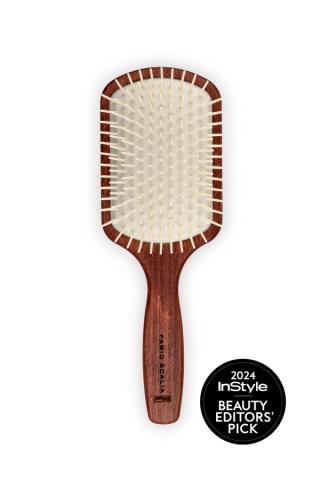
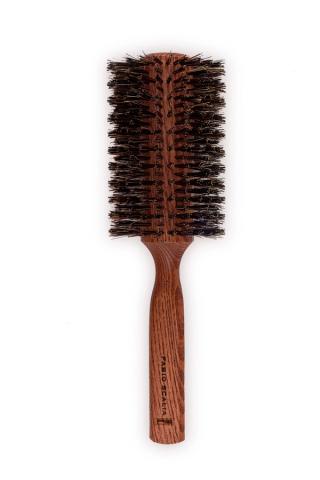
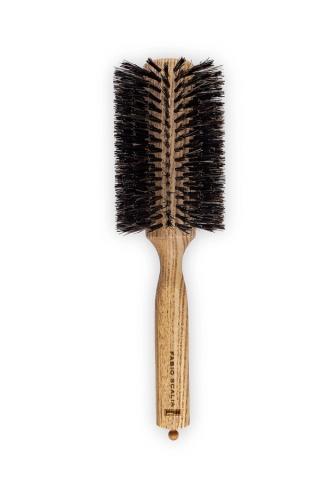
Fewer passes, less damage. Heat lifts the cuticle, and lifted cuticles are the mechanism behind most acquired porosity. Every extra pass with a dryer is more heat. A brush that clears a section in two passes instead of five is doing something measurable. That is the argument for a barrel sized to your hair rather than one brush for everyone. La Monica comes in three widths.
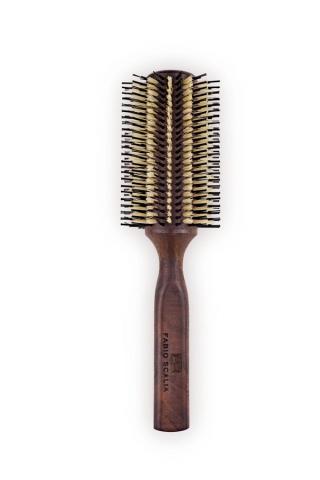
Shine is cuticle alignment. Boar bristle is keratin, the same protein your hair is made of. So it glides instead of dragging, and it lays the cuticle flat. That is where shine comes from. The limit is that boar is short and soft. On thick or dense hair it never reaches the scalp, which is why La Chiara runs French nylon pins through the boar to part the hair first.
Clean your brush. Residue on a brush is product you reapply every day without meaning to. It is what makes any home water test meaningless, and a variable worth controlling if you are also reading your scalp. Ciccio rakes out the trapped hair, Dada lifts the residue.
Porosity is the fourth lens, not the first. Texture, density and curl pattern decide the tool. Those are the three the brush quiz asks about.
Next wash, notice one thing only. Whether your ends saturate faster than your roots. If they do, that is your real answer, and it beats any number in a glass.
FS Collezione. Italian hair brushes for every kind of hair.
Frequently Asked Questions
What is hair porosity?
How readily the hair fiber takes up and holds water, products and chemical treatments. It depends on cuticle integrity and the internal structure of the strand.
Is porosity the same as texture, thickness or density?
No. Hair type is curl pattern, texture or thickness is strand diameter, and density is how much hair you have. Porosity is about water and product interaction, and about the condition of the fiber.
Is porosity genetic or caused by damage?
Both play a part. Baseline fiber characteristics vary from person to person. But porosity behavior shifts with bleaching, alkaline services, heat, sunlight and ordinary wear.
Can I have more than one porosity level on my head?
Yes, and almost everyone does. Processed or older ends have a different damage history from newer roots, so they behave differently.
Does hair that wets fast automatically have high porosity?
No. Fast wetting can come from surface chemistry, lipid loss, prior processing, product residue, temperature or the water itself. Useful to notice, not a diagnosis.
Does high porosity mean damaged hair?
It is often associated with cuticle damage, but it is not a full damage assessment. Wetting, internal pore structure, strength and breakage are separate properties.
Does low porosity mean healthier hair?
Not on its own. It usually means an intact hydrophobic surface layer, which is a good sign. It says nothing about strength, scalp health or whether your routine suits you.
Can products permanently open or seal the cuticle?
No. They change lubrication, friction, deposition, shine and water behavior, all temporarily. Permanent structural repair claims need fiber-level testing behind them.