What Is My Hair Type?
You have probably been handed a number already. Maybe 2B, or 3C, or 4A. Somebody said it out loud once, or a quiz decided it for you, and it has followed you around since.
That number describes one thing about your hair. It is not the thing that decides what your hair needs.
The short answer. Your hair type is the curl pattern of your strands, graded 1 to 4. Type 1 is straight, Type 2 is wavy, Type 3 is curly, Type 4 is coily. The letters A, B and C mark how tight that pattern runs inside each number. A is the loosest, C is the tightest. To find yours: wash your hair, use no product, let it air dry untouched, then look at one single strand.
Here is the full chart, the test that gets it right, and the parts the chart leaves out.
How do you find your hair type?
Wash your hair. Use no product. Let it air dry completely without touching it.
Most people mistype themselves because they judge their hair styled. Styling either flattens a pattern or fakes one. A round brush can turn a 2C into a 1B for a day. A diffuser can make a 2B look like a 3A.
Then look at a single strand. Not the whole head. Pull one hair forward and watch what it does on its own.
Is it flat, with no bend in it. Does it form an S. Does it spiral into a loop. Does it zigzag in sharp angles instead of curves.
That is your pattern. Match it below.
One note on wet versus dry. Pattern is easier to see on fully saturated hair. So if your dry hair is hard to read, check it soaking wet with nothing on it. Use both readings if they disagree.
The 1A to 4C hair type chart, explained
Type 1: straight
No visible wave or curl. The strand falls without a bend.
The chart splits this into 1A, 1B and 1C. These are the loosest definitions in the whole system and they get used inconsistently. Broadly: 1A is poker straight and fine, 1B carries some body, 1C holds a faint bend at the ends.
Type 2: wavy
The strand forms an S. It sits closer to the head than a Type 3 curl does.
2A. Fine, barely-there waves. Heavy product flattens them fast and leaves the hair limp.
2B. A more defined S. Flatter at the crown, clearer from the mid-lengths down.
2C. Thick, strongly defined waves that often start near the root. This one sits right on the border between wavy and curly. Frizz is the usual complaint.
Type 3: curly
The strand forms a loop, spiral, ringlet or corkscrew.
3A. Broad, loose, shiny spirals. About the width of a stick of sidewalk chalk.
3B. Springier, more compact ringlets. About the circumference of a permanent marker.
3C. Tight corkscrews, closer to a pencil or a straw. Dense, and high in volume.
Type 4: coily
Very tight curls, coils, bends or zigzags. They begin close to the scalp.
4A. Dense, springy, visibly defined S-shaped coils. About the circumference of a crochet needle.
4B. Densely packed strands with sharper bends. Closer to a Z than a spiral.
4C. Very tightly coiled or zigzagged. Often reads as undefined from a distance, with real shrinkage against its stretched length.
One fair thing to say about Type 4 while you are here. Coily hair can be fine and soft, or coarse and wiry. The pattern tells you nothing about the thickness or the strength of the fiber. It is not a measure of health, and it says nothing about growth.
Where this chart came from, and what it is not
This is the part most hair type guides skip.
The 1 to 4C chart is the André Walker Hair Typing System. A stylist created it in the 1990s. It is a consumer classification, built for talking about hair, and it is good at that.
It is not a validated diagnostic. A 2026 systematic review in the Journal of Cosmetic Dermatology found that several popular typing systems were developed for haircare marketing rather than for validated clinical use.
That review found four systems in mainstream use. The Walker chart is one. The other three come from the curl community and from L'Oréal. Its conclusion was that these charts genuinely improve how people talk about hair, and that curl-pattern classification may only have clinical value with more validation behind it.
There is a smaller surprise in the same paper. 4C, the label doing the most work in beauty culture right now, was not a formal entry in Walker's original chart. The comparison table lists 4A and 4B. The extension to 4C came from the community and the industry, not from the system itself.
None of that makes the chart useless. It makes it a shared vocabulary instead of a verdict. Which is the more useful thing to have.
Three things the chart leaves out
Thickness is not density
Density is how many strands you have. Thickness is how wide one strand is. The two get used as the same word constantly. They are not the same measurement.
Roll a single shed hair between your thumb and forefinger. Hard to feel is fine. Noticeable is medium. Distinctly substantial is coarse. Do it on ten or so hairs, not one.
For choosing a brush, that reading matters more than your curl number does.
Porosity is usually the real answer
Porosity is how fast your hair takes water in, and how fast it loses it again. The 1 to 4C chart does not measure it at all.
It is also why two people with the same number get completely different results from the same product. A cream works beautifully on your friend's 3B and sits on top of yours. That is porosity, not pattern. We cover it properly in what is hair porosity.
You probably have more than one type
Multiple patterns on one head is normal. The crown is usually looser than the nape. The hair around your face is often the finest on your head.
The research is blunt about it. Putting one label on a whole head is approximate by design. Type the majority and treat the rest accordingly.
Can your hair type change?
The underlying pattern is biological. Follicle curvature, fiber asymmetry and the way keratin is organized inside the strand all shape what grows out of your scalp.
How much of it you can see is a different question. Heat damage changes it. So do chemical services, mechanical wear from the wrong tools, hormones, length and humidity.
So treat your type as an observation, not an identity. If your curls have loosened over two years and nothing hormonal has shifted, look at your heat settings and your brush before you accept it as permanent.
Products will not change it either. They stretch a pattern, set it, define it or weigh it down for a day. They do not reach the follicle.
Why curly and coily hair feels drier
The geometry is doing it.
Sebum from your scalp travels down the hair shaft. In a tight coil the strand bends many times over a short distance, so that journey gets harder. The mid-lengths and ends get less of it.
That is physics, not a diagnosis. It does not mean your scalp is dry. The oil your scalp already makes is not reaching the places that need it. A distribution problem.
It is also the clearest argument for boar bristle. Boar is keratin, the same protein your hair is made of, so it glides instead of dragging. It moves that oil down toward ends that otherwise never get any. And it lays the cuticle flat, which is where shine actually comes from.
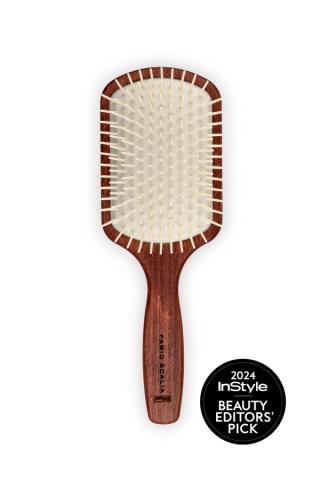
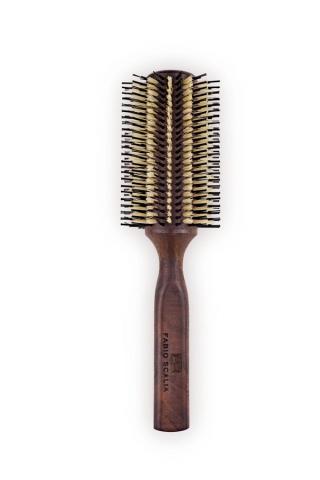
The limit is that boar is short and soft. On thick or tightly coiled hair it never reaches the scalp. That is why La Chiara runs French nylon pins through the boar to part the hair first.
What your type means for choosing a brush
Your curl number narrows the field. It does not pick the tool.
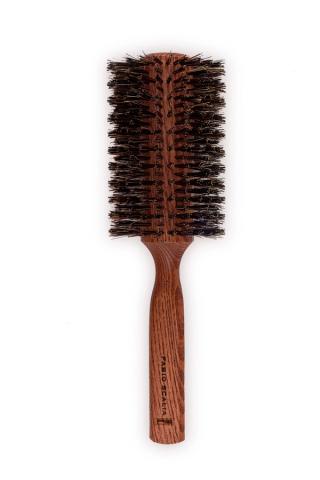
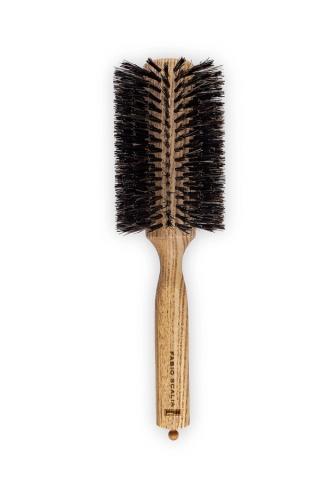
Straight and wavy, Type 1 and 2. A boar-and-nylon cushion brush handles daily brushing, smoothing and polishing. La Chiara is the place to start. For lift and shape through the lengths, a round brush like La Mora or La Sophia works with the dryer rather than against it.
Curly and coily, Type 3 and 4. Start with a wide-tooth comb on wet hair. Work from the ends up, never the roots down. Gio is a wide-tooth comb in beech and walnut, made for this. Brushing coils dry is how curl patterns break, so time it to the water, not the mirror.
Fine hair at any number. Thickness beats pattern here. Fine strands snap under tools that grab, and a brush that grabs takes hair with it every single time you use it. You never notice on the day. You notice six months later, when your ends look thin and you blame the color, or the water, or stress.
The common mistake is shopping by the curl and ignoring how much hair you have. Two people can both be 3B. One has fine, sparse hair that a dense brush will tear. The other has so much hair that a soft boar brush will never reach the scalp. Same number. Opposite tools.
If you want this narrowed properly, the brush quiz asks about thickness, density and what you actually do to your hair in the morning. That combination is what decides it.
Wash it, skip the product, let it dry, read one strand. Then roll a few between your fingers, because how wide they are will change your brush more than your curl number will.
FS Collezione. Italian hair brushes for every kind of hair.
Frequently Asked Questions
What do Type 1, 2, 3 and 4 mean?
Type 1 is straight, Type 2 wavy, Type 3 curly, Type 4 coily. The numbering describes the shape of the strand pattern. It says nothing about hair health, quality or ethnicity.
What do A, B and C mean in labels like 2B or 4C?
They mark how tight the pattern runs inside each number. A is widest and loosest, B is medium, C is smallest and tightest. So 2A is a loose wave. 4C is a very tight coil or zigzag.
Can I have more than one hair type?
Yes, and most people do. Looser waves at the hairline with tighter curls underneath is common. So is a looser crown with a tighter nape. Type the majority.
Is curl type the same as texture, density or porosity?
No. Curl type is the shape of the strand. Texture usually means how it feels or how wide it is. Density is how many strands grow from your scalp. Porosity is how your hair takes up and releases water. All three affect your results on their own.
What is the difference between 3C and 4A?
3C forms small distinct corkscrews. 4A forms tight visible S-shaped coils that start closer to the scalp. There is real overlap, especially on hair that is stretched, styled, wet or damaged.
Why does Type 4 hair shrink so much?
Shrinkage is the gap between coiled length and stretched length. A tight coil travels through many more bends over the same distance, so the hair reads much shorter than it is. It is a normal feature of the pattern, not evidence of breakage.
Can my hair type change?
The underlying pattern is biological. How visible it is changes with heat, chemical services, mechanical wear, hormones, length and humidity. Treat the label as a current reading.
Does my curl type tell me which products to use?
Only partly. It points you toward a goal, like lightweight definition for loose waves, or slip and moisture for tight coils. The rest needs your scalp condition, strand thickness, density, porosity, color history and climate.