What Is My Hair Density?
You have stood in front of a mirror and decided your hair is thinning. Most people have. Usually in bad bathroom light, with a part you made yourself, comparing today against a memory.
That is not a measurement. Here is what density actually is, and how to check yours in a way that means something.
The short answer. Hair density is how many hairs grow in a given area of your scalp. It is counted in hairs per square centimeter. A count, not a width. Low density means fewer hairs, and it says nothing about how thick each one is. You cannot count them properly at home. What you can do is track your own density over time, with repeatable part-line photos at the same three spots in the same light.
This is the third of four things that decide what your hair needs. The others are curl pattern, strand texture and porosity.
Density is not texture
Density is how many hairs you have. Texture is how wide one of them is.
They are measured in different units and they move independently.
So fine hair with high density is common. So is coarse hair with low density. One does not predict the other. This is the mix-up behind most of the confusion in hair language.
When someone says thin hair, they almost always mean low density. When they say thick hair, they usually mean high density. Neither statement is about texture at all.
Density is not fullness either
This is the part worth sitting with. Fullness is what you are actually looking at in the mirror.
Fullness depends on density. It also depends on strand width, curl pattern and length. Then on how much your hair color contrasts with your scalp. Then on what you did to it this morning, and the light you are standing in.
Density is one input of seven. A dark head of hair on a pale scalp reads thinner than the same density in a lighter color. Short reads fuller than long. Curls read fuller than straight.
Which is why a bad mirror moment is not evidence. Too many variables moved at once.
How to check your hair density at home
Start with the limit, because it is the important part.
You cannot count hairs per square centimeter at home. Real counts need magnification, a standardized sample area and trained image analysis. That is why clinics use trichoscopy or a phototrichogram.
What you can do is track your own trend. That is genuinely useful, and it is the only home method worth your time.
The part-line photo series
Pick three locations and never change them. The center part at the vertex, one temple or front hairline, and the back of the head.
Use the same sites every time. Density naturally differs across your scalp. Comparing your crown this month against your temple last month tells you nothing.
Then standardize everything else:
- Wash and dry your hair the same way before each photo
- Make the same width part with a tail comb
- Shoot straight down, same distance, same light, same camera settings
- Never compare a flat wash-day photo against a third-day style with product in it
Repeat every eight to twelve weeks. Not weekly. Shedding, styling and light shift too much week to week to show you anything real.
Then compare your own series against itself. Not against someone else's scalp, and not against a low, medium or high density chart you found online.
Write down what else was going on each time. Hair length, color, grays. Whether it was wet. Oils or dry shampoo, extensions, recent heat or chemical work. Illness, a medication change, postpartum, a big shift in weight or diet. Any of those moves the picture.
The scalp visibility check
In bright indirect light, look at your hair before you part it anywhere.
If your scalp shows easily across several unparted areas, your density may be lower. Or your strands may be finer. The check cannot tell you which. That is its ceiling.
If visibility has clearly increased against your older standardized photos, document it and get professional trichoscopy.
One thing not to do: judge low density from a single center part. A part exposes scalp on purpose. That is what a part is.
The ponytail test, and what it is not
Gather a low ponytail at the same position, without pulling, and measure the circumference with a soft tape.
Then treat that number as a personal trend line and nothing else.
Circumference moves with length, breakage and curl pattern. Also layering, blow-drying, extensions, where you are in the shedding cycle, and strand width. Density is one of many things inside it. Two people with identical densities can have very different ponytails.
How many hairs per square centimeter is normal?
There is no personal benchmark, and that is the honest answer.
Published averages from healthy study groups span roughly 148 to 230 hairs per square centimeter. That range comes from a multiethnic study of healthy volunteers. It varies by population group and by scalp region. The authors present it as group averages, not individual targets.
Method moves the number too. A 1994 comparison found a phototrichogram significantly underestimated density against a unit-area trichogram. 181 against 237 hairs per square centimeter. Same scalps. Different tools. A 56-hair gap.
A 2024 trichoscopy study put average total density around 194.7 hairs per square centimeter. That counts terminal and vellus hairs together.
So if you are handed one number as your normal, ask which study, which scalp site and which device. There is no version of this where a single figure applies to everyone.
Your density is different across your own head
Density varies by region, and the pattern is not identical in every population.
A 2022 study of 120 participants measured three sites. 143.9 hairs per square centimeter at the front, 147.1 at the vertex, 153.6 at the occiput. A separate 2024 trichoscopy analysis of healthy men found the frontal and occipital regions denser than the temporal ones.
Practical version: your temples are often the sparsest part of your head, and always have been. Comparing a temple against your crown will worry you for no reason.
Pick your three sites, keep them, and compare like against like.
Density changes with age
A 2024 trichoscopy study found terminal hair density had a small but statistically significant negative relationship with age. Vellus hair density went the other way and rose with age.
Small is the operative word. This is a gradual trend, not a cliff, and it is a normal part of getting older.
It is also why your baseline matters more than any published average. Your density at 45 against your density at 44 is informative. Your density against a stranger's is not.
There is also a difference between follicles and hairs
Worth knowing, because it explains something odd.
Hairs grow in follicular units, and a unit usually holds one to four hairs. So two people can have a similar number of units per square centimeter and still differ in total density. One of them averages more hairs per unit.
So density is not simply how many follicles you were born with. It is how many hairs those follicles are producing now.
When a change in density needs a doctor
This section is not cosmetic, so it is separate from the rest.
Lifelong lower density is a normal variation. A change is different information.
Take these to a dermatologist rather than to a product:
- A part that keeps widening
- Scalp becoming visible in areas away from your usual part
- Noticeably less bulk in a ponytail over months
- Thinning that is getting worse, or is patchy
- Any scalp that is itchy, sore, inflamed or scaly
- Loss that came on suddenly
There is more on all of this in is my hair thinning. Female pattern hair loss commonly shows up as reduced density. It is usually most obvious over the central scalp, though it can present more diffusely. It is also a condition where timing matters. That is the real argument for getting it looked at early rather than tracking it alone for a year.
A clinician measures this with magnification. Your photo series is useful history, and worth bringing to the appointment. It is not a diagnosis.
Can you increase your hair density?
It depends entirely on the cause. Which is why nobody can tell you from a photo.
Some reductions are shedding-related and recover as the hair cycle normalizes. Pattern hair loss works differently. It involves miniaturization, and that one benefits from being assessed early.
What will not change it is a brush, a shampoo or a serum bought off a before-and-after. Products change how hair behaves and how full it looks. They do not change how many hairs are growing.
Counting hairs in your shower drain will not tell you either. Shed counts reflect one moment in a cycle. They also move with how often you wash. Density is a count in an area of scalp, not a count in a drain.
What density means for your brush
Texture tells you whether a tool will snap your hair. Density tells you whether it can get through it. Different question, different answer.
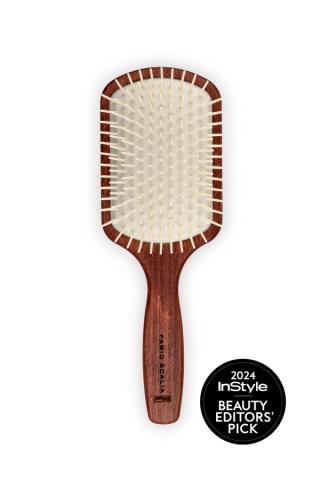
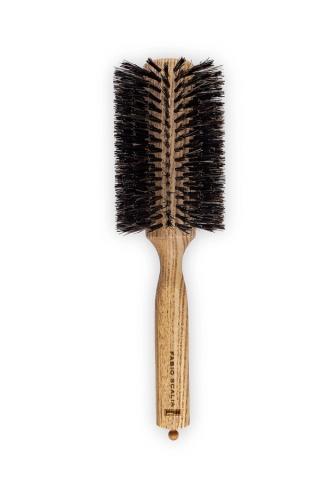
Low density. The risk is doing damage you cannot afford. Fewer hairs means every one you lose shows. So the priority is a brush that moves through instead of grabbing. A paddle brush that detangles gently rather than forcing through is the right build, which is what La Claudia is for. If you also blow-dry for volume, La Bionda is a ball-tip round brush made for fine hair specifically. Go lighter on product too. Weight reads as flatness faster when there is less hair to hold the shape.
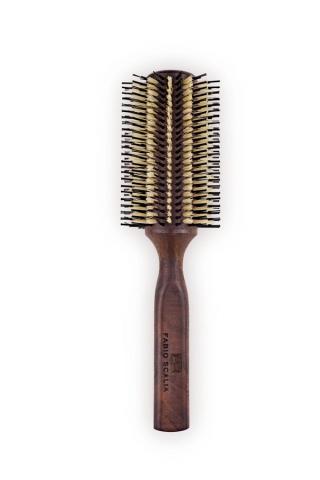
Medium density. The most flexible position. La Chiara is a boar-and-nylon cushion brush for daily brushing, smoothing and polishing. Boar for shine, nylon pins to part the hair first.
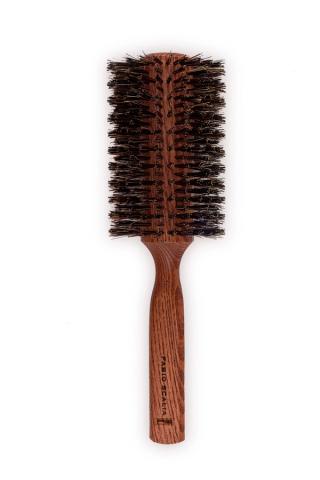
High density. The opposite problem, and the one people underestimate. Boar bristle is keratin, the same protein your hair is made of. So it glides instead of dragging, and it lays the cuticle flat. The limit is that boar is short and soft. On dense hair it never gets near the scalp, so you need pins through the boar to part it first. Detangle properly before you dry, with a wide-tooth comb like Leo. Then use a barrel sized to your hair, so the work takes fewer passes. La Monica comes in three, and it is built for coarse, curly and textured hair.
That is density on its own. In practice it works with your texture and your curl pattern. All three together are what pick the brush, which is what the brush quiz asks for.
Pick your three spots, take the photos, then leave them alone for three months. A trend you can actually see beats a mirror you cannot trust.
FS Collezione. Italian hair brushes for every kind of hair.
Frequently Asked Questions
What is hair density?
The number of hair fibers growing in a defined area of scalp, conventionally counted as hairs per square centimeter.
Is hair density the same as hair texture or thickness?
No. Density is how many hairs sit in an area. Texture is the diameter of one of them. Different units, measured separately.
Can I have fine hair but high density?
Yes, and plenty of people do. Fine means narrow strands. High density means many of them. The two coexist happily.
Can I have coarse hair but low density?
Yes. Wider strands create some bulk. They tell you nothing about how many hairs are growing per square centimeter.
How can I measure hair density at home?
You cannot count it. What works is repeatable part-line photography. Same three scalp spots, same light, every eight to twelve weeks. That gives you a trend, not a number.
How many hairs per square centimeter is normal?
There is no personal benchmark. Healthy study averages run roughly 148 to 230 hairs per square centimeter. It depends on the population and the scalp site. The measurement method shifts the figure too.
Why does my part look wider?
It can be reduced density, finer strands or breakage. It can also be how the hair is sitting, oil, moisture, lighting, or the contrast between your hair and your scalp. Widening that keeps going is worth documenting and taking to a clinician.
Can I increase my hair density?
It depends on the cause. Some shedding-related reductions recover as the cycle normalizes. Pattern hair loss involves miniaturization and needs proper assessment. Either way the cause comes before the treatment.