What Is Hair Elasticity?
Your hair has been the same length for two years. You have assumed it stopped growing.
It probably did not. It is growing from the follicle and fracturing at the ends faster than you can keep it. That is a breakage problem, and elasticity is how you spot one.
The short answer. Hair elasticity is how far a strand stretches under tension, and how well it returns without permanent deformation or snapping. In a lab it is measured with tensile tests. Elastic modulus, break extension, break stress. At home you can do a rough version by stretching a damp strand. It will tell you whether your hair is currently fragile. It will not tell you why, and it cannot diagnose anything.
Do not label your hair high or low elasticity. Read it as a snapshot of current fragility. Compare several strands from different areas, and watch how it changes after a service or a routine change.
Elasticity is not strength, and it is not porosity
Three things get used interchangeably and they are separate measurements.
Elasticity is about deformation and recovery. How far it goes, whether it comes back.
Tensile strength is about how much stress a fiber takes before it breaks. Hair can feel flexible and still have weak break strength. It can also feel stiff from a styling-product film while holding reasonable strength underneath.
Porosity is about how readily hair takes up and loses water and chemicals. Damaged hair is often both more porous and weaker, but you cannot read porosity off a stretch test.
There is a good reason these resist being collapsed into one score. A 2022 methodological analysis of wet tensile testing identified 14 separate stress, strain and work variables. Hair mechanics do not reduce to a single elasticity number. Any content that gives you one is inventing it.
How much should hair actually stretch?
There are published reference points, and they come with a warning attached.
A 2015 review in the International Journal of Trichology reports a figure for virgin hair. It can generally stretch about 30 percent beyond its original wet length without damage. Permanent changes happen between 30 and 70 percent extension. Fracture comes around 80 percent.
Now the warning. Those are laboratory figures from controlled tensile experiments. They are not targets.
If you pull a strand at home trying to reach 30 percent, you will create the damage you were testing for. The numbers are there to tell you hair has a finite limit, not to give you a benchmark to hit.
So ignore any guide that tells you healthy hair stretches 50 percent. Nobody is measuring that in a bathroom, and attempting it is actively harmful.
The wet stretch test, done properly
It is an observational check for obvious fragility. That is the whole of its usefulness, and it is still worth ten minutes.
Take several strands, from different places. Crown, mid-lengths, nape, ends. Naturally shed or minimally handled. One visibly split strand does not represent your head. Standardized sampling is a large part of why lab testing beats this.
Work with damp hair, not dripping. Water gets absorbed into the shaft and swells it, which changes the mechanics. Keep the wetness consistent if you plan to compare over time.
Use clean hair. Oils, silicones, conditioners, styling polymers and plain residue all change slip, friction and apparent stretch. A coated strand is not telling you about the fiber underneath it.
Support both ends. Hold the strand between fingertips with a short section exposed. Never tug from the scalp.
Go slow and gentle. Lengthen it just enough to see what it does. Do not chase a percentage.
Then look for a pattern. A few weak ends is normal, because ends are older and have been through more. Consistent snapping across several sections is the finding that matters.
Reading the result
It stretches a little and returns close to its original length. Broadly consistent with flexible hair. It does not prove your hair is undamaged, and it says nothing about your cuticle.
It barely stretches and snaps fast. Consistent with brittle or weathered hair. More so if it comes with rough texture, tangling, split ends, heat exposure, bleach or aggressive detangling.
It stretches unusually far, feels gummy, and does not spring back. That points to real mechanical alteration from chemical or thermal damage. Stop pulling. Reduce heat, space out chemical services, cut friction. Get it looked at if it is widespread.
The wet test looks bad but your dry hair feels fine. Not a contradiction. Wet and dry tensile measurements respond differently to treatment and to humidity. A 2022 study found wet and dry modulus had only a weak relationship with each other. The same paper concluded wet modulus was the most useful single measure of chemical and physical damage.
Moisture versus protein does not hold up
This is the framework the whole internet runs on. Hair that barely stretches needs moisture. Hair that stretches too much needs protein.
It is an oversimplification, and the research does not support using a home stretch test to make that call.
A stretch test gives you a rough mechanical response. It cannot identify a compositional deficit, and it cannot tell you which ingredient category to buy. Treatment history, friction, humidity, water uptake, fiber structure. All of that is inside one result, and the test cannot separate them.
What is fair to say is simpler. Hair that snaps easily is fragile. Fragile hair benefits from less heat, fewer chemical services and lower friction. That holds no matter which of the two camps you were about to put yourself in.
On oils, since they come up here. A 2003 comparison tested mineral, sunflower and coconut oil. Coconut was the only one that reduced protein loss in both damaged and undamaged hair, used before and after washing. The proposed reason was its affinity for hair proteins, and its ability to get into the fiber.
Worth knowing. Also worth keeping in proportion. Oil films change friction and water uptake. They do not rebuild damaged keratin.
Breakage is not shedding
Two different events, two different explanations, and people conflate them constantly.
Breakage is a fracture along the length of the fiber. It leaves short, uneven pieces with blunt or frayed ends.
Shedding is a whole hair releasing from the follicle. It usually has a small club-shaped bulb at one end.
Look at the ends of what comes out. The bulb is the tell.
They can happen at once, but the fix is different. Breakage is a shaft problem. You address it with handling, heat and chemistry. Shedding is a follicle question, and it belongs with scalp and medical assessment.
And not every short hair is breakage. It can be new growth, regrowth after shedding, or just a shorter layer. Breakage is more likely when the ends are blunt or frayed and the lengths are uneven. More so with splits, and an exposure history to match.
Where it breaks tells you something
Not a diagnosis. A useful clue.
At the ends. Usually accumulated weathering. Ends are the oldest hair you own. They have taken the most washing, brushing, sunlight, heat, chemistry and friction against clothing and bedding.
Mid-shaft. Often tangling, brushing, friction or hot tools.
Around the hairline or temples. Suggests tension or traction. Tight ponytails, buns, braids, cornrows, extensions and weaves can break strands outright, and sustained pulling can contribute to traction alopecia.
Short fragments versus longer segments. Dry combing is more associated with short-segment breaks. Wet combing is more associated with longer-segment breaks, particularly in straight to wavy hair. The force peaks through the mid-lengths.
That last distinction is genuinely actionable, because it tells you which habit to change.
Why hair gets fragile
It is almost always cumulative rather than one event.
Weathering. Progressive deterioration of the shaft from root toward the older ends. Raised or missing cuticle, more porosity, exposed cortex, cracks, higher friction.
Friction, and this is the underrated one. When the cuticle is lifted, chipped or lost, fibers catch on each other. Higher friction means more tangling. More tangling means more force to comb, which drives more breakage. A loop.
Everyday mechanics. Detangling, brushing, towel drying, elastic tension, rubbing against fabric, pulling at tangles. All cumulative, all possible on hair that has never been colored.
Chemical services. Bleaching, coloring, relaxing, perming and high-alkaline straightening all alter the fiber. The cuticle, the cortex, and the intercellular regions holding it together. Bleaching is the most demanding, because lightening requires chemical oxidation.
Heat, and it is dose-dependent. Temperature, number of passes, contact time and frequency all matter. Lower settings, fewer passes, air drying where you can, and heat protection reduce the stress. They do not erase it.
Damage starts before anything snaps. Washing friction, rough drying, sunlight, heat and bleach all damage the cuticle and the cell-membrane complex. That happens well before you see a single broken hair. By the time it snaps, it has been going on for a while.
When to see a dermatologist
Most fragility is cosmetic weathering. Some is not.
Get it assessed for:
- Widespread snapping that came on suddenly
- A marked change in texture
- Scalp pain, scaling, redness or pustules
- Bald patches or focal hair loss
- A clear drop in density
There are also hair-shaft disorders that cause fragility directly. Trichorrhexis nodosa is one: nodes or weak points along the shaft that make strands break easily. It can be inherited or acquired, and acquired cases are commonly linked to chemical treatment, mechanical trauma and weathering.
A stretch test cannot find any of that. It is not what it is for.
What elasticity means for your brushing
This is the one trait where your tool is part of the mechanism rather than next to it.
The chain runs like this. Damaged cuticle raises friction. Higher friction means more tangling. More tangling means more force to get a brush through. More force means more breakage, which damages more cuticle. It compounds.
So the single thing that matters is whether your brush moves through the hair or catches on it. If a tool grabs instead of moving through, it takes hair with it every time you use it. You never notice on the day. You notice two years later, when your hair has been the same length the whole time.
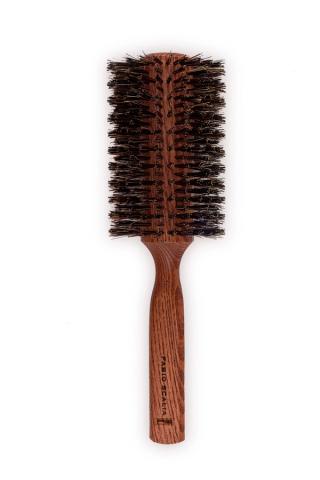
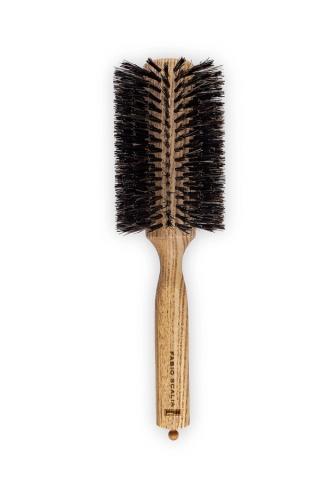
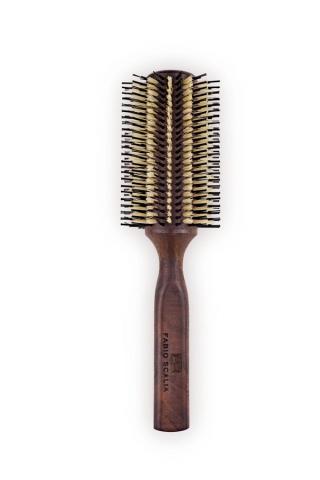
Boar bristle lowers the friction. Boar is keratin, the same protein your hair is made of. So it glides instead of dragging. It also lays the cuticle flat, and a flat cuticle catches less. The limit is that boar is short and soft. On thick or dense hair it never reaches the scalp. La Chiara runs French nylon pins through the boar to part the hair first.
Wet detangling depends on your texture, and the rule is not universal. For most people, wet hair breaks more easily when combed or brushed. So the American Academy of Dermatology advises handling it less. But for tightly curled or textured hair, the same guidance says detangling while wet may reduce breakage. Curls and coils have bends and points of diameter variation that act as weak spots. Dry detangling can be the more damaging option there. Either way: a wide-tooth comb like Gio, worked from the ends up, in sections, with slip in the hair.
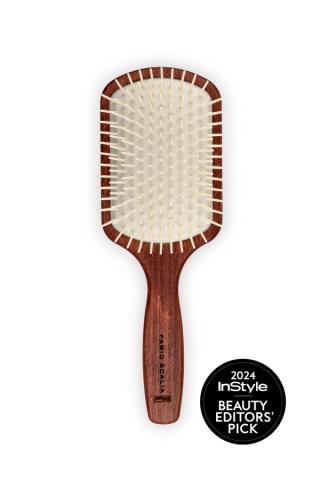
Already fragile. Go gentler than feels necessary. Work in smaller sections, so you are never forcing through a tangle. A paddle brush built to detangle gently rather than pull, which is what La Claudia is for.
Fewer dryer passes. Heat is dose-dependent, and every extra pass is another dose. A brush that clears a section in two passes instead of five is a real reduction.
Clean the brush. Old sebum and old product on the bristles add drag. Drag is the thing you are trying to remove. Ciccio pulls the trapped hair out, Dada lifts the residue off.
One honest note. Conditioner does more for breakage than any brush does. It lubricates the surface, improves combability and lowers combing force. That is exactly the lever that matters here. It also cannot regenerate a fractured shaft, and neither can we. What a good brush does is stop you adding to the problem.
Your elasticity does not pick your brush. Texture, density and curl pattern do, and those three are what the brush quiz asks about.
Go find a few shed hairs and stretch them gently. If they snap straight away, the useful question is not which product to buy. It is which part of your routine pulls hardest.
FS Collezione. Italian hair brushes for every kind of hair.
Frequently Asked Questions
What is hair elasticity?
The ability of a single fiber to stretch under tension and recover without permanent deformation or breaking. It is one component of hair mechanics, and it is not the same as tensile strength.
Is the wet strand stretch test accurate?
It can flag obvious fragility. It is not a validated diagnostic. Wet versus dry conditions, strand variation, chemical history, heat, product residue and how hard you pull all change the result.
How much should healthy wet hair stretch?
A frequently cited reference says virgin wet hair can stretch about 30 percent without damage. That is a laboratory figure, not a target. Pulling to a percentage on purpose will damage the strand.
Why does my hair snap when wet?
Water swells the shaft, and a swollen fiber stressed past its tolerance fractures. More likely when the cuticle and cortex have been weakened by bleach, color, relaxer, heat, sunlight, friction or rough wet detangling.
Why is my hair stretchy or gummy when wet?
Excessive stretch with poor recoil suggests real mechanical alteration from chemical or thermal damage. A home test cannot identify the mechanism. Stop pulling, cut heat and chemical exposure. Get advice if it is widespread or sudden.
Does breakage mean my hair stopped growing?
No. Hair can grow normally from the follicle while the oldest lengths fracture faster than you retain them. That looks like stalled growth and it is not.
Do split ends cause breakage?
Split ends are structural damage and they can travel upward through weakened cortex and cuticle. Trimming removes the split you have. Preventing the next one means less friction, less heat and gentler handling.
Is breakage always caused by heat?
No. Heat is one contributor. So are bleaching, dyeing, relaxing and sunlight. So are tangles, rough towel drying, tight styles, traction and plain friction. Occasionally an underlying hair-shaft disorder.
Can conditioner actually prevent breakage?
Yes, in the sense that matters. It lubricates the surface, improves combability and lowers combing force. That reduces future mechanical damage. It cannot regenerate a hair that has already fractured.