What Is My Hair Texture?
Somebody has told you that you have thin hair. Somebody else has told you it is thick. Both of them were probably looking at the same head.
The words are doing two different jobs and nobody says which one they mean. So here is the distinction that fixes it.
The short answer. Your hair texture is the width of one single strand, graded fine, medium or coarse. Not how much hair you have. Not whether it is straight, wavy, curly or coily. To find yours: take several clean, dry, naturally shed hairs and roll one at a time between your thumb and forefinger. Hard to feel is fine. Noticeable but not pronounced is medium. Distinctly substantial, almost wire-like, is coarse.
That test matters more for choosing a brush than your curl number does. Here is how to run it properly.
How do you find your hair texture?
Collect several shed hairs first. Off a clean brush, off your pillowcase, out of the shower on wash day.
Avoid anything freshly heat-styled, oiled or heavily conditioned. Product changes how a strand feels between your fingers. That feel is the whole test.
Let them dry completely. Then take hairs from more than one area of your scalp. Not just the handful nearest your part.
Roll one strand between the pad of your thumb and your index finger.
Hard to feel at all. Fine.
You can feel it, but it is not pronounced. Medium.
Distinctly substantial, almost like a thin wire. Coarse.
Do it on ten to twenty hairs. Go with whatever comes up most. Mixed diameters are normal, so you want the majority reading, not a unanimous one.
Skip the broken-off pieces and skip the one unusually thick strand. Neither represents your head.
Why not the sewing thread test
You have probably seen this one. Hold a hair against a sewing thread, thinner is fine, wider is coarse. Skip it.
Thread comes in a wide range of thicknesses, so you are comparing against a moving target. Hair is not a perfect cylinder either. And diameter varies between hairs taken from the same person, so one strand against one thread is a single data point.
Your fingers are the better instrument here. If you want something visual, lay a clean dry strand on white paper in strong daylight, or photograph it magnified.
Fine, medium and coarse, explained
Fine hair
A relatively small fiber diameter. It is often hard to detect at all between clean fingertips.
Fine hair is weighed down easily. There is less material in each strand. So a heavy cream or a thick oil lands harder than it would on a coarse head.
It is not fragile by definition. Fine is a natural trait, not a diagnosis.
Medium hair
An intermediate diameter, and the most forgiving of the three. Most products behave roughly as the label promises.
Medium is also the vaguest of the three. There is a reason for that, below.
Coarse hair
A relatively large fiber diameter. You can feel it immediately.
Coarse is not a synonym for rough, dry, damaged or unmanageable. It describes width. A coarse strand can be perfectly smooth. Roughness usually comes from cuticle wear, chemical processing, heat or buildup.
Coarse hair does tend to need more conditioning and more smoothing support. That is a real difference in behavior, not a flaw.
The numbers, and why they do not agree
Adult scalp hair runs roughly 20 to 180 microns wide. That range comes from a 2014 paper on the structure of human hair.
The useful thing to know is that the cutoffs inside that range are not settled.
One clinical study used under 60 microns for fine, 60 to 80 for thin and over 80 for thick. A separate trichoscopy study classified terminal hair as medium at 30 to 50 microns. Those two definitions barely overlap.
They are not contradicting each other. They measured for different purposes, at different scalp sites, with different equipment, in different populations.
So fine, medium and coarse are good descriptive words. They are bad medical cutoffs. If a brand quotes you an exact micron figure for coarse hair, it picked one study.
Texture is not density
Density is how many hairs grow out of a given area of scalp. Texture is how wide one of them is.
These are measured separately and they move independently.
So you can have fine hair and a great deal of it. A dense head of fine strands looks fuller than a sparse head of coarse ones. You can also have coarse hair that reads as thin. Strand width does nothing for coverage if the strands sit far apart.
This is the most common mix-up in hair language. Thin hair almost always means low density. Thick hair usually means high density. Neither one tells you anything about texture.
Texture is not curl pattern
Fine coily hair exists. So does coarse straight hair, and medium wavy hair, and every other combination.
Curl pattern comes from the shape of the follicle and the geometry of the fiber. Texture is the width of that fiber. They are set by different things and they do not predict each other.
Worth saying plainly, because this one carries baggage. Straight does not mean fine. Curly does not mean coarse. A study of 2,249 adults across 24 ethnic groups found wide variation in diameter between populations and within them. Averages exist. They cannot tell you about one person's head.
Curl pattern is a separate test. It is in our guide to hair type.
Your texture is not the same all over your head
Diameter can differ by scalp zone. One clinical study found average terminal-hair diameter differed between the frontal and occipital scalp. A separate study in an adult Thai population found no significant difference across the sites it measured.
So scalp variation is real. It is not universal, and it is not the same in every population.
Sample a few areas, take the majority, treat the rest accordingly. The hair around your face is often the finest on your head anyway.
When finer hair is worth a conversation
Most of this article is cosmetic. This part is not, so it is worth separating out.
A lifelong fine texture is just your hair. A change is different information.
Things worth taking to a dermatologist or a trichologist rather than to a product:
- Hair that has noticeably changed diameter over months
- A conspicuous mix of very thin strands alongside normal ones
- A part line that is widening
- Shedding that has increased and stayed increased
Clinicians assess this with magnification, not by feel. In trichoscopy the signal is the variation itself, not the width. A 2024 analysis reports that a 20 percent hair-diameter-diversity threshold is clinically validated for androgenetic alopecia. The same paper notes those thresholds may need adjusting by population.
A 2022 clinico-trichoscopic study measured 50 terminal hairs per scalp region. Mean diameters fell with more advanced grades of female-pattern hair loss. Frontal means went from 52.77 microns at grade 1 down to 42.30 at grade 3.
None of which makes fine hair a symptom. On its own it is not evidence of hair loss. Clinicians look at variation, distribution, history and the scalp itself. Which is exactly why a fingertip test is the wrong tool for that question.
Can you change your hair texture?
Not with anything you put on it.
Volumizing products, protein treatments and texturizing sprays do work. They change how hair feels and how much space it takes up. Friction, stiffness, coating, apparent body.
What they do not do is make the strand wider. The hair above your scalp is not living tissue. It will not grow outward because you conditioned it.
Newly growing hair can come in at a different diameter. That is biology. If it happens suddenly, or keeps going, see the section above.
What your texture means for your brush
This is where texture earns its keep. It changes the tool more than curl pattern does.
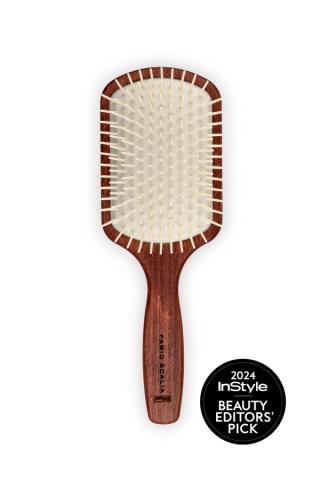
Fine hair. The risk is tearing, not frizz. Fine strands snap under anything that grabs, which is an elasticity problem as much as a texture one. And a brush that grabs takes hair with it every single time you use it. You never notice on the day. You notice six months later, when your ends look thin and you blame the color, or the water, or stress. Soft flexible pins and a cushioned base do real work here. That is what Gabri is built around. Go easy on heavy product too, since fine hair shows the weight first.
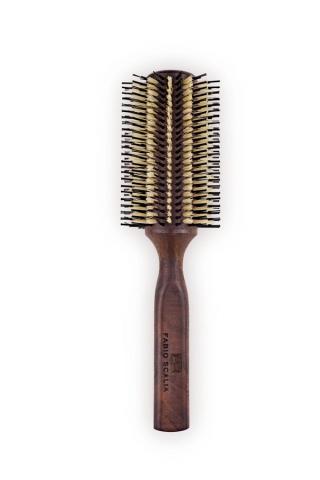
Medium hair. The versatile middle. La Chiara is a boar-and-nylon cushion brush for daily brushing, smoothing and polishing. Boar for shine, nylon pins to part the hair first.
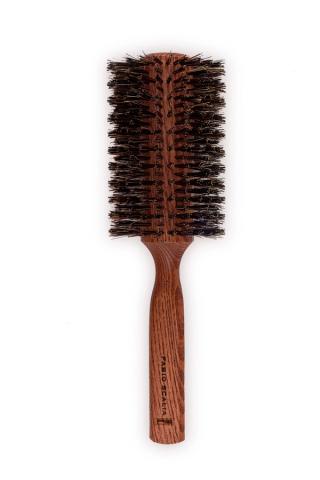
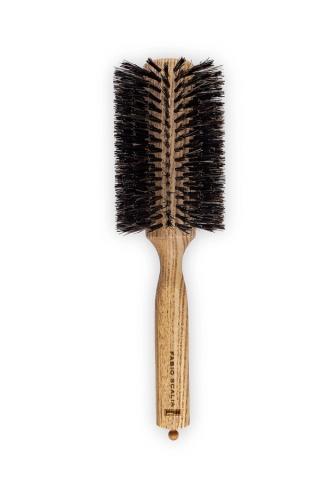
Coarse hair. The opposite problem. Boar bristle is keratin, the same protein your hair is made of. So it glides instead of dragging, and it lays the cuticle flat. The limit is that boar is short and soft. On coarse or very dense hair it never reaches the scalp. You need pins through the boar to get there. A wider barrel also does more per pass on thick hair, which is why La Monica comes in three. On wet coarse hair, start with a wide-tooth comb like Gio. Work from the ends up.
The honest version is that texture is one input of three. Density and curl pattern are the other two. A brush recommendation needs all three, which is why the brush quiz asks for them together.
Pull ten hairs off your brush tonight and roll them between your fingers. That reading, plus how much hair you have, gets you closer to the right brush than any chart will.
FS Collezione. Italian hair brushes for every kind of hair.
Frequently Asked Questions
What does hair texture mean?
In the fine, medium and coarse sense, it means the diameter of one individual strand. Not how much hair you have, and not whether it is straight, wavy, curly or coily.
How do I tell whether my hair is fine, medium or coarse?
Roll a clean, dry, shed strand between your fingertips. Fine is hard to feel. Medium is noticeable but not prominent. Coarse feels distinctly substantial. Check ten to twenty strands from a few areas rather than trusting one.
Is fine hair the same as thin hair?
No. Fine is the width of each strand. Thin usually means lower density, or less hair overall. You can have fine hair and a lot of it.
Is coarse hair the same as thick hair?
Only if thick means each strand. In everyday use, thick hair almost always means high density, which is a separate trait.
Can I have fine hair that is curly or coily?
Yes. Curl pattern and strand diameter are independent. Fine and coily, medium and wavy, coarse and straight all exist.
Why does my hair feel finer in some places?
Individual hairs vary, and diameter can differ by scalp area. A new or growing contrast is different information. Especially around the hairline, crown or part. That one is worth a clinician, not a new product.
Can products permanently change fine hair into coarse hair?
No. They can make strands feel fuller, firmer and more substantial for a day. They cannot widen a hair that has already grown.
Does texture affect which products work?
Yes. Fine hair is weighed down by heavy formulas. Medium is versatile. Coarse usually needs more conditioning and smoothing support. Density, porosity, damage and curl pattern all factor in too.