Is My Hair Thinning?
You noticed it in a photograph. Or in a ponytail that wraps one more time than it used to.
Then somebody told you it is just age, and you half believed them. That explanation is the most common one people reach for, and it is usually the weakest one available.
The short answer. Density does fall with age across a population. Mean density runs around 293 hairs per square centimeter at 35, and around 211 at 70. But age is a very poor predictor for any one person. And no density number separates normal variation from hair loss. What tells you something is the pattern, your own history, and the rate of change. If it is changing, that is worth a dermatologist rather than a product.
"It is just age" is usually the wrong answer
Two studies look like they disagree. They do not, and the resolution is the useful part.
Birch and colleagues measured 377 women aged 18 to 99. All of them had come to a clinic for reasons unrelated to hair. Mean density was 293 ± 61.3 hairs per square centimeter at age 35. At 70 it was 211 ± 55.1.
So the average falls. Clearly.
Then Sinclair and colleagues looked at 1,666 scalp biopsies. They came from 928 women aged 13 to 84. Each additional year of age cost 0.077 follicles per biopsy. That is 0.22 percent a year.
More to the point: age explained under 2 percent of the variance in total hair count. The authors called age and miniaturization "extremely weak predictors."
Put those together. Population averages decline with age. Your own density barely tracks your age at all.
Which means age is a description, not an explanation. If something changed in the last two years, something other than your birthday did it. Accepting age as the reason is how treatable things get left for years.
No number can tell you
This is the finding that should change how you think about it.
Birch also found that hair density is normally distributed. It behaves like height. Most people cluster near the middle, some sit high, some sit low, and all of it is normal.
And the women clinically diagnosed with female pattern hair loss had densities below the average. Still inside the normal range.
Read that again, because it matters. There is no cutoff. No count separates hair loss from ordinary low density. Someone can have more hair than you and be losing it. You can have less and be perfectly stable.
What distinguishes them is pattern, history and rate of change. That is why a dermatologist asks when it started, and whether it is still moving. Not just what you measure once.
It is also why you cannot settle this at home. More on what you can do in what is my hair density.
Thinning is not shedding
These get used as the same word. They are different events.
Shedding is whole hairs releasing from the follicle. It fluctuates constantly. Normal is roughly 50 to 100 a day. The number matters far less than whether yours has changed.
Thinning is a sustained reduction in density or in shaft diameter. It persists.
You can shed heavily for a month with no change in density at all. You can also thin steadily and never notice a thing in the shower.
Check the end of what comes out. A shed hair has a small club-shaped bulb. A broken one does not. Breakage is a different problem again, and it is covered in hair elasticity.
And counting what is in the drain tells you very little. Shed counts capture one moment in a cycle and move with how often you wash.
What actually makes density fall
Pattern hair loss
The most common cause in adults. Genetically sensitive follicles produce progressively finer, shorter shafts. That process is called miniaturization.
It is far more common in women than the conversation suggests. In Birch's sample, 6 percent of women under 50 had female pattern hair loss. By 70 and over it was 38 percent.
Menopause
The numbers here are striking. A 2022 study assessed 178 healthy postmenopausal women aged 50 to 65. On average they were around nine years past menopause.
Female pattern hair loss prevalence was 52.2 percent.
The reassuring half of that finding is severity. Most of it was mild. Graded on the Ludwig scale, 73.2 percent was the mildest stage, 22.6 percent the middle stage, and 4.3 percent the most advanced.
After adjusting for age and family history, one factor was still significantly associated with it. A body mass index of 25 or above.
Telogen effluvium
A temporary shift that pushes many follicles into the resting phase at once. Illness, surgery, a medication change, a big change in diet, acute stress, childbirth.
The postpartum version is the one most people meet. It commonly starts a few months after birth, peaks around month five, and settles by month eight. Density itself can take 12 to 18 months to look normal again. Hair grows slowly, even once the shedding has stopped.
Worth being honest about the evidence. Those timings come from clinical guidance rather than one definitive study. Treat them as a typical arc, not a schedule.
Traction
Caused by sustained pulling. Tight ponytails, buns, braids, cornrows, extensions, weaves.
The important part is timing. Early traction alopecia is fully reversible. If the tension continues, it can progress to scarring alopecia. That one is not.
Exposure accumulates. In a South African school study, prevalence ran 8.6 percent among first-year students. Among girls in their final year it was 21.7 percent.
If you wear tension styles and you are thinning at the hairline or temples, that is the one on this list you can act on today. Loosen it.
How to track it properly
You cannot count hairs at home. What you can do is build a record. A record is genuinely useful at an appointment.
Pick three locations and never change them. The center part at the vertex, one temple, the back of the head.
Wash and dry your hair the same way each time. Make the same width part. Shoot straight down. Same distance, same light, same camera settings.
Then leave it alone for eight to twelve weeks. Shedding, styling and lighting all move too much week to week to show you anything.
Write down what else was happening. Hair length, color, whether it was wet. Recent chemical services, illness, a medication change, postpartum, a big shift in weight or diet.
Compare your own series against itself. Not against someone else's scalp, and not against a chart you found online.
When to see a professional
This is the part that matters more than anything above it.
Book an appointment for any of these:
- A part that keeps widening
- Scalp becoming visible away from your usual part
- Distinct bald patches, especially if they appeared suddenly
- Shedding that has increased and stayed increased for more than a few weeks
- Noticeably less bulk in a ponytail over months
- A scalp that is sore, itchy, scaling, crusted or has pustules
- Thinning at the hairline or temples if you wear tension styles
- Hair loss alongside fatigue, unexplained weight loss, or changes to your skin or nails
Early assessment is not fussing. For pattern loss and for traction, some follicle change becomes permanent. The window where treatment works best is early. Waiting to see if it settles is the thing to avoid.
A clinician assesses this with magnification, and sometimes a biopsy. Your photo series and your history are what you bring. They are not a diagnosis. Neither is this article.
One more thing worth saying plainly. Female pattern hair loss affected over half the postmenopausal women in that 2022 study. If you are in that group and nobody has ever raised it with you, that is a gap in the conversation. Not evidence that nothing is happening.
What a brush can and cannot do
Nothing in our range treats hair loss. No brush does, and no brush will.
What a tool changes is whether you add breakage on top of whatever else is happening. That matters more when there is less hair. Every strand you lose is a bigger share of what you have.
So the useful version is narrow:
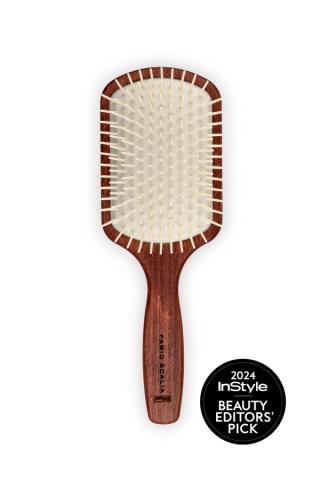
Stop adding to it. A brush that catches takes hair with it every time you use it. A paddle brush that detangles gently rather than forcing is the right build. That is what La Claudia is for. On wet or textured hair, a wide-tooth comb like Gio, worked from the ends up.
Loosen the style. The only item on this list that prevents a real condition. Tension causes traction alopecia, and early traction alopecia reverses.
Leave an irritated scalp alone. Do not brush over skin that is sore or inflamed. See scalp type.
For a tool matched to the hair you actually have, the brush quiz asks about texture, density and curl pattern together.
If something has changed, write down when it started and whether it is still moving. That sentence is worth more at an appointment than any number you could measure at home.
FS Collezione. Italian hair brushes for every kind of hair.
Frequently Asked Questions
How much hair loss per day is normal?
Roughly 50 to 100 hairs. The count matters much less than whether it has changed from your own baseline, and stayed changed.
Does hair density naturally decrease with age?
On average, yes. One study found mean density fell from 293 hairs per square centimeter at 35 to 211 at 70. But another found age explained under 2 percent of the variance in individual hair counts. So it is a weak explanation for your own hair.
Is my thinning normal or is it hair loss?
No density number answers that. Women with diagnosed female pattern hair loss had densities inside the normal range, just below average. Pattern, history and rate of change are what separate them.
Why is my hair thinner since menopause?
A 2022 study found female pattern hair loss in 52.2 percent of postmenopausal women aged 50 to 65. Most of it was mild. Falling estrogen shortens the growth phase while androgen exposure continues.
Will my postpartum hair loss grow back?
Postpartum shedding is temporary. It typically starts a few months after birth, peaks around month five, and settles by month eight. Visible density can take 12 to 18 months, because hair grows slowly.
Is shedding the same as thinning?
No. Shedding is whole hairs leaving the follicle, and it fluctuates. Thinning is a sustained drop in density or shaft diameter. Heavy shedding can happen with no change in density at all.
Can tight hairstyles cause permanent hair loss?
Early traction alopecia is fully reversible. Continued tension can progress to scarring alopecia, which is not. Years of exposure raise the risk substantially.
When should I see a dermatologist rather than wait?
Sudden, patchy or painful loss. A widening part. A sore or scaling scalp. Shedding that has stayed high for weeks. Loss alongside other symptoms. Early is better, because some follicle change does not reverse.